-

Trong một vài tuần nay, đất nước Nam Mỹ này đã nỗ lực chuẩn bị sẵn sàng tâm thế để cân nhắc một cách nghiêm túc về việc sử dụng năng lượng hạt nhân. Ngày 18 tháng 2 vừa qua, ông Jaime Salas đã được bổ nhiệm là giám đốc Hội đồng Năng lượng Nguyên tử Chile (Comisión Chilena de Energía Nuclear, CCHEN), chỉ 1 tuần sau chuyến thăm chính thức của ông cùng Bộ trưởng bộ năng lượng - khai khoáng Chile tới Pháp và Bỉ, thăm quan nhà máy điện hạt nhân Tihange.
-

America is yearning for leadership, and energy policy is another area where it is lacking. Democrats argue we must do more to promote and develop alternative fuels. Republicans counter that there is no alternative to oil and gas in the short term and that we need to increase our domestic output to secure our energy supply.
-

The annual survey of cell manufacturers published in the March 2011 issue of PHOTON International shows that the PV industry increased global cell production to 27.2 gigawatts (GW) in 2010, which is as much as the output of the previous 4 years combined. This incredibly large volume means an increase of 118-percent over the 12.5 GW produced in 2009 - the highest annual growth rate since PHOTON International started tracking cell production in 1999.
-

Richard MacLellan, Halifax Regional Municipality’s SEMO Manager (Sustainable Environment Management Office) remarked that adopting solar heating technology was a good cost- effective proposition. As the demand for hot water was very high in the building, the opportunity for savings by decreasing the operating costs in the facility was also huge. He mentioned that they would continue their exploration to discover the most promising and innovative renewable technology that could be used in the projects.
-

Senator Joe Lieberman called for a temporary halt on the building of nuclear plants in the U.S., and many news organizations have reported that it could cause a major setback for U.S. nuclear policy. Last year, the Department of Energy announced $8.3 billion in loan guarantees for the construction of two nuclear plants in Georgia. The plants are part of a major push by President Obama and Energy Secretary Steven Chu to support nuclear power in the United States.
-

Australia’s national science agency is collaborating with leading universities on an 8.3-million Australian dollar ($8.17 million) research collaboration to use enzymes to produce biofuels from waste plant feed stocks. The Commonwealth Scientific and Industrial Research Organization’s Energy Transformed Cluster on Biofuels seeks viable ways to transform waste plant materials into a sustainable low-emission fuel for cars, trucks and even planes.
-

IDTechEx recently visited GS Caltex in Seoul, Korea, who have developed a solid state lithium thin film battery. The company is a joint venture between GS, Korea and Chevron, USA, and its core business is oil refinery where they are number two in Korea. The company also works on renewable energy including fuel cells, biofuels, materials for supercapacitors and thin film batteries.
-

Under the RCUK programme, Nanoscience through Engineering to Application, the EPSRC and the Technology Strategy Board (TSB) are investing in four industry-led collaborative research and development projects that will address challenges in building the supply chain and scaling up technologies.
-

Restoring power and government reconstruction spending are crucial to Japan's economy resuming growth, the IMF said Thursday, after Tokyo put the damage of the March 11 earthquake at $309 billion. International Monetary Fund officials said they expected a short-term slowdown, but growth would "rebound" to pre-quake levels and more.
-

The first new nuclear reactor ordered in the U.S. in roughly three decades is beginning to take shape near Augusta, Ga. Southern Company and its partners have dug 27.5 meters down to reach bedrock and are now refilling the hole to provide a stable, anchored foundation for what is likely to be the first of a new generation of reactors in the U.S.: two new AP1000 models at the Vogtle Electric Generating Plant that stand next to two older pressurized water reactors, which came online in the 1980s—the first of some 14 AP1000s and 20 new reactors in total that may be built in the U.S. in the next 15 years.
-

In doing so, it will launch the Agency for the Cooperation of Energy Regulators (ACER), to take decisions on cross border energy supply. ACER will draft framework guidelines for the operation of cross border electricity networks, establishing rules that are consistent with these guidelines, the Commission said. Its role will be to monitor the newly managed internal European electricity market, including retail prices, available network access for electricity produced from renewable sources.
-

Poland's government approved two bills creating a legal framework for the nuclear power industry and taking another step towards building the country's first nuclear plant, the government said in a statement on Tuesday. The bills, which now will be sent to parliament, create grounds for oversight of the investment process by National Atomic Energy Agency (PAA) as well as instruments for state-controlled PGE to choose technology supplier.
-
Chín phủ Hà Lan đã thông qua hai dự luật nhằm xây dựng khung pháp lý cho công nghiệp điện hạt nhân và tiến tới xây dựng nhà máy điện hạt nhân đầu tiên ở nước này. Hai dự luật này đã tạo ra nền tảng cho hoạt động giám sát quy trình đầu tư của Trung tâm Nguyên tử Quốc gia (PAA), đồng thời là công cụ để PGE (công ty sản xuất điện thuộc sự quản lí của nhà nước và có quy mô lớn nhất của Phần Lan ) có thể lựa chọn nhà cung ứng công nghệ.
-

American consumers don’t want things forced on them by the government, but they are slowly starting to become aware of energy issues via the rising cost of energy and the geo-political climate, said Crane. “Everyone in this room has a vested interest in electric vehicles becoming successful,” said Crane to the room largely made up by investors, and the future is “all about electric vehicles.”
-

Solar Junction is a 4-year-old company spun out of Stanford University that designs high-efficiency, multi-junction solar cells for concentrating photovoltaic (CPV) solar collectors. The National Renewable Energy Laboratory recently certified that its solar cells can operate at 40.9% efficiency, a significantly higher efficiency than typical silicon solar cells that convert sunlight to electricity at an efficiency of about 15-20%.
-

Scientists are reporting development of an advanced lithium-ion battery that is ideal for powering the electric vehicles now making their way into dealer showrooms. The new battery can store large amounts of energy in a small space and has a high rate capacity, meaning it can provide current even in extreme temperatures.
-

France's consumption rose by 7% – and in Europe only Denmark and Ireland used less energy per unit of GDP than UK.The EU energy commissioner, Günther Oettinger, is expected to recommend member states are set individual targets on efficiency improvements.The UK is one of the top performers in Europe on energy efficiency, according to a European commission report.
-

Wind turbine prices last year fell below 1 million euros ($1.4 million) a megawatt for the first time since 2005, Bloomberg New Energy Finance said. Global turbine contracts signed in the last six months of 2010 for delivery this year averaged 980,000 euros a megawatt, the London-based analyst said today in a statement. That’s down from 1.06 million euros for contracts signed in 2009 and a peak of 1.21 million euros in 2007 and 2008, the group said.
-

The Umeox Apollo is named after the Greek Sun God, and comes with a built-in solar panel covering the rear of the phone allowing the user to place a call when the batteries are discharged, provided there is sufficient sun available. Daily usage recharge needs about 2.5 hours of sunlight with a complete recharge requiring 17 hours.
-

CyberSmart Africa implements a practical and scalable solution to enlighten the frequently ignored rural schools with contemporary education. Funded by the United States Agency for International Development (USAID), CyberSmart’s “tech-lite” approach, which includes a specially adapted interactive whiteboard and other low-power digital tools, puts learning first. The system uniquely focuses on teacher training and puts the latest low-power, portable equipment to work directly in the classrooms of off-the-grid rural schools.








 Kế hoạch hành động của Bộ Công Thương thực hiện Chỉ thị số 09/CT-TTg của Thủ tướng Chính phủ
 Bộ Công Thương phát động "Toàn dân sử dụng năng lượng tiết kiệm hiệu quả và hưởng ứng Chiến dịch Giờ Trái đất năm 2026"
 Thủ tướng Chính phủ Chỉ thị tăng cường thực hiện tiết kiệm năng lượng, thúc đẩy chuyển dịch năng lượng và phát triển phương tiện giao thông điện









 Sử dụng năng lượng hiệu quả - "Chìa khóa" bứt phá tại Công ty TNHH Panasonic Industrial Devices Việt Nam
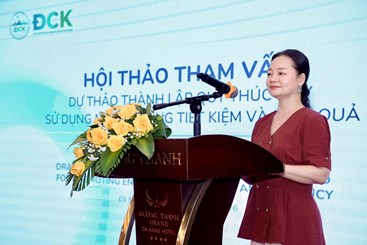 Tham vấn Dự thảo thành lập Quỹ thúc đẩy sử dụng năng lượng tiết kiệm và hiệu quả
 [PODCAST TKNL] Sử dụng năng lượng tiết kiệm, hiệu quả trong doanh nghiệp, công trình và hệ thống điện hiện đại
 Hội nghị sử dụng năng lượng tiết kiệm và hiệu quả toàn quốc năm 2026
 Polytex tiên phong tiết kiệm năng lượng trong ngành dệt nhuộm
 Khai mạc Hội chợ Triển lãm Sản phẩm Tiết kiệm năng lượng, Chuyển đổi xanh 2026
 Chính sách, công nghệ và tài chính thúc đẩy tiết kiệm năng lượng trong công nghiệp