

-
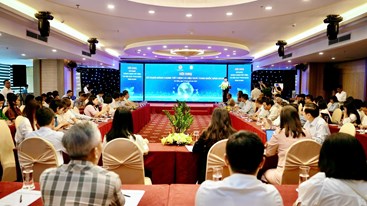
Qua 2 lần tổ chức Entech Hanoi đã thực sự gây tiếng vang và để lại ấn tượng tốt đối với cộng đồng doanh nghiệp hoạt động trong lĩnh vực năng lượng, môi trường trong và ngoài nước.
-
A group of engineers at Bridgestone America’s Technical Center in Akron, along with students from DeLaSalle School in Kansas City have recently developed a new all-electric car which has been successfully tested on Bridgestone’s Texas Proving Grounds.
-
Before joining the cleaner production component in the industry (CPI), during the production process, Ngoc Lap tea factory used to encounter major environmental problems such as high concentration of dust, noise pollution, and smoke from burning coal, which directly affected the working conditions of employees, worsen living condition in the neighborhoods and schools near the factory. The amount of carbon dioxide emission from the plant is about 2,500 tons per year.
-
Two co-authors Nguyen Trong Kien and Nguyen Van Hoang of Nguyen Hoang Tuy Company (Ho Chi Minh City) have successfully implemented a system for remote control and supervision of public lighting, detection of electrical leak system via SMS. Accordingly, in addition to remote controlling lighting of public lamps, the system is also capable of detecting current leakage status and reporting to the management department for prompt react.
-
Ocean Renewable Power Company (ORPC), an industry leader in tidal, river and deep-water ocean current energy technology and projects, announced today that its Beta Power System, the largest ocean energy "power plant" ever installed in U.S. waters, has successfully generated grid-compatible power from tidal currents at its Cobscook Bay site in Eastport, Maine.
-
One purpose of developing solar power technology is to support the load for the national grid and enable consumers to use EVN’s electricity at peak hours with price of off-peak hours (price of grid electricity at night is only 500 dong per Kwh, while during peak hour it is about 2000 dong, calculated accumulatively).
-
The Prime Minister has approved a VND3trillion project to train and develop human resources for the atomic energy field from now until 2020.
-
When you think of electric cars, you generally mean two terms in which they exist: autonomy vs charging infrastructure. These two words compete with each other to a certain point, because higher autonomy means less infrastructure needed, hence faster adoption by the market.
-
Finns get almost one third of their electricity second-hand, after industrial users have had first dibs at it. Vesa Koivisto of Fortum (the largest utility in Scandinavia) told me that paper mills actually supply about one third of the electricity on the grid. Why?
-
This has led to the increased production of PV cells not only in Europe but also in Taiwan and china. China alone produces 2GW solar cells annually. In February 2010 the price of electricity using PV panel is $4.27 per watt. Today the price of photovoltaic cells of different companies is different. The General electric solar panel costs $ 228 to $385. This trend would decline with more competition.
-
Diễn ra trong 3 ngày từ 8 đến 10 tháng 9 năm 2010, Triển lãm và hội thảo quốc tế lần thứ 4 về phát triển năng lượng và bảo vệ môi trường Việt Nam 2010- ENERGY & ENVIRONMENT VIETNAM 2010 sẽ được tổ chức tại Trung tâm triển lãm Quốc tế IEC - 91 Trần Hưng Đạo,Hà Nội.
-
Chi Thanh Ice Manufacturing Ltd based in My Tho, Tien Giang is specialized in providing ice for offshore fishing vessels. The technological process mainly uses electric. So energy saving solutions mainly focus on electric efficiency, especially in key consumption areas such as compressors and heat pumps.
-
Intimex Thanh Chuong Tapioca Factory, under Nghe An Intimex branch, was put into operation in 2004. The factory has increased the capacity twice: from 60 to 120 tons per day and from 120 to 180 tons per day.
Its coal consumption and the rate of raw cassava over cassava products used to be much higher compared to other factories in Vietnam which have similar scale. Consumption of the company in 2008: 3.7 million kWh of electricity per year; 2.8 million kilograms of coal; 27,000 kilograms of diesel oil. After joining the Component of Cleaner Production in industry of the Ministry of Industry and Trade, leaders of the company has made several concrete measures in energy efficiency.
-
In production of bricks with semi plastic technology, a specialized machine system is used to process the raw materials, mixing them together into a specific blend used for each particular type of product such as building bricks, roofing tiles or floor tiles. After that, the mixture is shaped and transferred to the kilns for burning.
-
The first building construction using non-fired building materials in Ha Noi is the Keang Nam 70-storied building. The owner of this project has transported the entire discarded constructional materials and soil from digging the foundation to Hue Quang Commerce and Technology Joint stock company (Hue Quang Company). This company will buy the discarded soil from Keang Nam to produce non-fired eco bricks and sell them back to Keang Nam. This is regarded as the model that sets the trend of using environment friendly materials in Vietnam.
-
In the under developed countries like India and Bangladesh masses ride bicycle rickshaw to carry commuters. This practice has been in use from centuries and this has become their culture now. In India the pedal power industry still accounts for 18 percent of the total industry. India has the largest bicycle industry after china. Along with the energy benefits that pedal power offers, bicycle has proved to be the great ride.
-
An innovative clean energy collaboration between auto manufacturer Ford, utility Detroit Edison and energy storage systems builder Xtreme Power plans to bring to Michigan one of its largest solar energy systems, which will be used to help in the production and usage of electric vehicles. The system will be installed at Ford’s Michigan Assembly Plant.
-
According to statistics, currently, the number of small and medium enterprises (SMEs) of Da Nang accounts for about 90% of total enterprises. Annually, the energy consumption of Da Nang is about 800 million kWh, in which, commercial electricity for production is about 700 million kWh. Besides, in the production process, large amounts of FO and DO oil used are also increasing every year.
-
Many simple methods can be applied to save at least 5-10 percent of electricity consumption, for example turning off electrical equipment when use is not necessary or operating air conditioners at suitable temperatures. However, many companies still ignore these simple methods.
-
The federal government has turned to a 130-year-old Hawaii sugar grower for help in powering the Navy and weaning the nation off a heavy reliance on fossil fuels. It will spend at least $10 million over the next five years to fund research and development at Maui cane fields for crops capable of fueling Navy fighter jets and ships. The project also may provide farmers in other warm climates with a model for harvesting their biofuel crops.